The Strategic Value of Passive Income Colored Icons in Modern Design Workflows
Understanding the Visual Economy of Clean Iconography
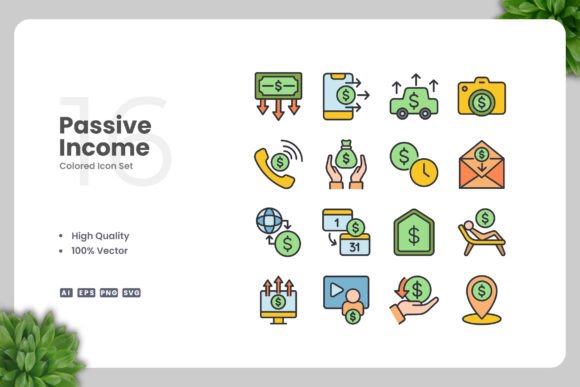
In digital product development, visual assets are no longer secondary considerations. They function as core communication tools that shape user perception, guide interaction, and reinforce brand identity. Passive Income Colored Icons represent a specific category of design resources that combine aesthetic clarity with functional versatility. These icons, rendered in carefully chosen color palettes and minimalist forms, serve a wide range of professional applications without demanding extensive customization from the end user.
The term "passive income" in this context refers not only to the financial model behind selling icon sets but also to the workflow efficiency these assets provide. When designers, educators, or marketers purchase a ready-made icon library, they save countless hours of production time. This time saving translates into a form of passive operational value — the asset works continuously across multiple projects without requiring repeated effort. The colored aspect adds another layer of utility: icons arrive pre-styled, reducing the need for color theory adjustments or brand alignment tweaks during initial deployment.
Core Characteristics of High-Quality Icon Sets
A well-constructed icon collection built around the Passive Income Colored Icons framework exhibits several defining traits that separate it from generic clip art or hastily assembled vector packs. Understanding these characteristics helps professionals evaluate which sets merit investment and integration into their workflows.
Vector Architecture and Scalability
Every icon in a premium set is constructed using vector paths rather than raster pixels. This means the artwork is defined mathematically — by points, curves, and fills — rather than by fixed pixel grids. The practical consequence is infinite scalability. Whether the icon appears on a mobile app interface at 24 pixels or on a trade show banner at 24 inches, the edges remain crisp, the curves stay smooth, and the color fills stay uniform. Vector architecture also ensures that file sizes remain small regardless of the output dimensions, which improves website load times and app performance.
Color Fidelity and Palette Design
Pre-colored icons remove the guesswork from visual hierarchy. A thoughtfully designed set uses color to convey meaning: green for financial growth, blue for trust and technology, orange for calls to action, and neutral tones for background elements. The Passive Income Colored Icons approach typically employs a cohesive palette of between four and twelve colors, ensuring that icons from the same set look harmonious when used together. This eliminates the jarring effect that occurs when mismatched color schemes collide in a single interface or document.
Format Flexibility Across Ecosystems
Professional icon sets ship in multiple file formats to accommodate different software environments and output requirements. A comprehensive collection includes:
- Source File Ai — Native Adobe Illustrator files that preserve all layers, color swatches, and editable paths.
- EPS Version 10 — A widely compatible vector format that opens in CorelDRAW, Affinity Designer, Inkscape, and older versions of Illustrator.
- SVG File — Scalable Vector Graphics for direct use in web development, React components, and mobile app asset catalogs.
- PNG Transparency — Pre-rendered raster images with alpha channels, ready for drag-and-drop placement in slide decks, social media posts, and print layouts.
- Readme.txt — Documentation that explains licensing terms, attribution requirements (if any), and file organization.
This multi-format delivery ensures that Passive Income Colored Icons work immediately in design software, code editors, content management systems, and office productivity tools without requiring format conversion.
Real-World Application Spectrum
The utility of colored icon sets extends across nearly every content creation vertical. Below are representative use cases drawn from actual professional environments where Passive Income Colored Icons have proven valuable.
Website and Mobile App Interfaces
Modern user interfaces rely on icons to communicate function without text. A navigation bar might use a house icon for "home," a magnifying glass for "search," and a shopping cart for "checkout." When these icons are pre-colored and stylistically consistent, the interface gains a polished, professional appearance without requiring the development team to hire a dedicated icon illustrator. For mobile apps, where screen real estate is limited, colored icons also help users locate features faster by leveraging color recognition alongside shape recognition.
Social Media Content and Digital Marketing
Social media managers produce dozens of visual posts per week. Using a consistent icon set across posts, stories, and cover images creates a recognizable visual brand. A financial advisor, for example, might use Passive Income Colored Icons themed around money, growth charts, portfolios, and retirement planning. The color consistency across these posts signals professionalism and trustworthiness to followers. Additionally, because the icons are vector files, they can be resized to fit Instagram squares, LinkedIn banners, Twitter headers, and Pinterest pins from a single source file.
Books, E-books, and Educational Materials
Authors and educators use icons to break up text-heavy pages, illustrate concepts, and create infographic-style summaries. A book about passive income strategies might include icons representing rental properties, dividend stocks, affiliate marketing, and digital product sales. When these icons are colored consistently, the reader forms visual associations that aid memory and comprehension. For self-published authors working with limited budgets, purchasing a ready-made icon set is far more economical than commissioning custom illustrations for each chapter.
Infographics and Data Visualization
Infographics rely on a combination of data points and visual metaphors. Icons serve as the metaphorical layer, helping viewers grasp abstract concepts quickly. An infographic about multiple income streams might use a row of colored icons — each representing a different source — with accompanying statistics. The clean design of Passive Income Colored Icons ensures that the icons do not distract from the data. Instead, they reinforce the narrative structure of the infographic.
Print Materials: Flyers, Banners, and Posters
Print design imposes unique constraints. Resolution must be high enough for ink reproduction, colors must be converted to CMYK or spot color systems, and elements must be arranged for readability at various viewing distances. Vector icons excel in this environment because they can be scaled to fill a poster or reduced to fit a business card without quality loss. A startup promoting a new passive income course might use colored icons on a flyer to highlight key benefits: flexible hours, recurring revenue, and low startup costs. The same icons can later be reused on a banner for a trade show booth, maintaining brand consistency across physical and digital touchpoints.
Customization Workflows for Different User Profiles
One of the primary advantages of vector-based Passive Income Colored Icons is the ability to modify them according to specific project needs. The level of customization required varies by user type.
Design Professionals
Graphic designers and UI/UX professionals typically work in Adobe Illustrator or CorelDRAW. They can open the Source File Ai or EPS Version 10 and access every component of the icon. Changing a color involves selecting a path and applying a new swatch. Designers might also adjust stroke weights, rotate elements, or combine multiple icons to create composite symbols. Because the files are organized with named layers and groups, these edits take seconds rather than hours.
Developers and Web Creators
Web developers prefer SVG files because they can be embedded directly into HTML or imported into JavaScript frameworks like React or Vue. To change an icon's color in SVG, the developer edits the fill or stroke attributes in the code. Many modern workflows also use SVG sprite sheets, where multiple icons are combined into a single file for efficient loading. The clean path structure of Passive Income Colored Icons ensures that SVGs remain lightweight and render consistently across browsers.
Non-Designers and Content Creators
Not everyone who uses icons has access to professional design software. For these users, the PNG Transparency files are the most practical option. They can be dragged and dropped into Canva, PowerPoint, Google Slides, Keynote, or any basic image editor. While color changes are not possible with PNG files without additional software, the pre-colored designs are selected to work well in common scenarios. Users who need different colors can request a custom version from the icon set creator or use simple online tools to overlay color tints on the transparent PNGs.
Technical Considerations When Selecting Icon Sets
Choosing the right icon collection involves more than aesthetic preference. Several technical factors affect how well the set will perform across your intended use cases.
File Organization and Naming Conventions
A well-structured icon set follows a logical naming convention. Instead of generic names like "icon01.svg," the files should be descriptive: "passive-income-rental-property.svg" or "colored-icon-affiliate-marketing.svg." This makes it easy to locate specific assets, especially when the set contains 100 or more icons. The folder structure should separate file formats clearly, with subdirectories for AI, EPS, SVG, and PNG variants.
Color Consistency Across Formats
When examining a set, verify that the colors in the SVG files match the colors in the PNG files and the EPS files. Discrepancies can occur if the designer exported each format with different color profiles. Premium Passive Income Colored Icons sets maintain strict color fidelity across all delivered formats. This is particularly important for brands that have specific hex code or CMYK values for their identity colors.
Licensing and Usage Rights
The Readme.txt file should clearly state whether the icons are licensed for commercial use, personal use, or both. Some sets require attribution, while others are royalty-free with no attribution needed. For businesses creating products or marketing materials, a license that permits modification and redistribution within derived works is essential. It is also worth checking whether the license covers use in templates, mobile apps, or printed merchandise if those are part of your distribution model.
Maximizing the Passive Income Potential for Creators
For designers and illustrators, creating and selling icon sets represents a genuine passive income stream. A single set, once designed and uploaded to a marketplace, can generate sales for years with minimal ongoing effort. However, success depends on understanding what buyers value.
Market Research Before Creation
The most commercially successful icon sets address specific niches. Rather than creating a generic "business icons" set, a creator might focus on "passive income colored icons" with designs tailored to real estate, digital products, investments, and side hustles. Buyers searching for those specific themes are more likely to purchase than those browsing generic categories. Including both popular and emerging topics within the set increases its shelf life.
Quality Assurance Across Deliverables
Every file in the set must be tested before release. SVG files should be validated for correct XML structure. EPS files should be tested in at least two different vector applications. PNG files should be checked for jagged edges or incomplete transparency. A single broken file can lead to negative reviews and refund requests, undermining the passive income potential. The Readme.txt file should include basic troubleshooting tips and contact information for support.
Pricing and Bundling Strategies
Icon sets are typically priced between $5 and $30 depending on the number of icons, the complexity of the designs, and the exclusivity of the license. Bundling multiple related sets — for example, a passive income icon pack combined with a finance dashboard UI kit — can justify a higher price point while providing greater value to the buyer. Creators should also consider offering a free sample of five to ten icons to demonstrate quality before purchase.
Long-Term Value and Reusability
The true measure of an icon set's worth is not the initial purchase price but the cumulative value it provides across years of use. A single collection of Passive Income Colored Icons might appear in dozens of slideshows, multiple websites, several books, countless social media posts, and a rotating set of print materials. Each reuse generates value without additional cost. This is why professionals are willing to invest in premium icon sets rather than relying on free alternatives that lack consistency, format variety, or customization options.
Free icon repositories often provide limited formats — typically only SVG or PNG — and rarely include editable source files. They also tend to have inconsistent styling because different contributors follow different design guidelines. Paid sets, by contrast, offer a unified visual language, guaranteed file integrity, and the flexibility to adapt to changing project requirements. For anyone serious about design efficiency, the upfront investment in a quality icon library pays dividends many times over.
Final Observations on Design Asset Economics
The market for design assets — including icons, templates, fonts, and mockups — continues to grow as more businesses and individuals create digital content. Passive Income Colored Icons occupy a specific and valuable position within this market. They combine the scalability of vectors with the immediacy of pre-applied color, serving both expert designers and non-designers alike. Whether you are building a mobile app, designing a book cover, or creating a social media campaign, a well-chosen icon set reduces production time, improves visual consistency, and elevates the perceived quality of your work.
For creators, the opportunity to generate passive income by designing these assets remains accessible. The key is to focus on quality, format completeness, and niche relevance. For buyers, the decision to invest in a premium set should be guided by the range of included formats, the clarity of the licensing terms, and the aesthetic fit with your existing brand materials. When these factors align, colored icons become not just decorative elements but strategic assets that enhance communication across every medium.